
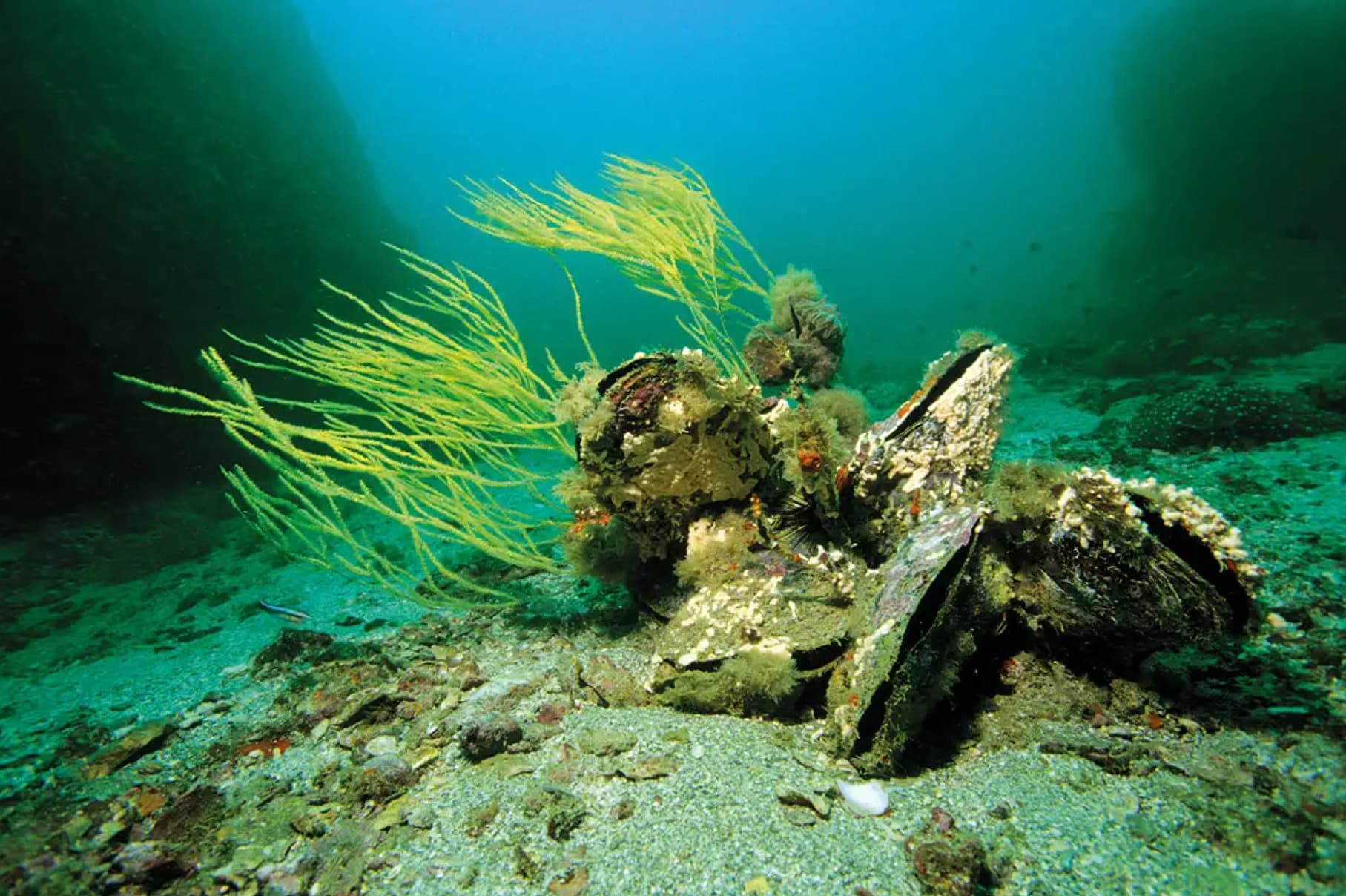
The Science
Oysters sequester
and store carbon
Capturing carbon dioxide in the marine environment reduces atmospheric CO₂.
- of all CO₂ emitted from fossil fuels and industrial processes is currently held in the Earth's oceans.
- 35–48%
of all CO₂ emitted from fossil fuels and industrial processes is currently held in the Earth's oceans.
- of water filtered by one adult oyster, removing suspended particles as it feeds.
- 50gal / day
of water filtered by one adult oyster, removing suspended particles as it feeds.
- filtered daily by a 130-acre reef at ten adult oysters per square meter.
- 260M gal
filtered daily by a 130-acre reef at ten adult oysters per square meter.
- the number of Houston wastewater treatment plants needed to match that volume.
- 39plants
the number of Houston wastewater treatment plants needed to match that volume.
The carbon dioxide emissions from the use of fossil fuels and industrial processes enter the Earth’s ocean–atmosphere system, where both the ocean and the atmosphere act as reservoirs that are constantly exchanging CO₂.
Studies show that between 35 and 48 percentof the total CO₂ emissions from the use of fossil fuels and industrial processes — like cement manufacturing — are currently in the Earth’s oceans.1
The process of continual exchange means that unless it is captured and stored, CO₂ in the ocean can and will re-enter the atmosphere. Sequestration in the marine environment is therefore not a side note to atmospheric carbon — it is the same ledger.
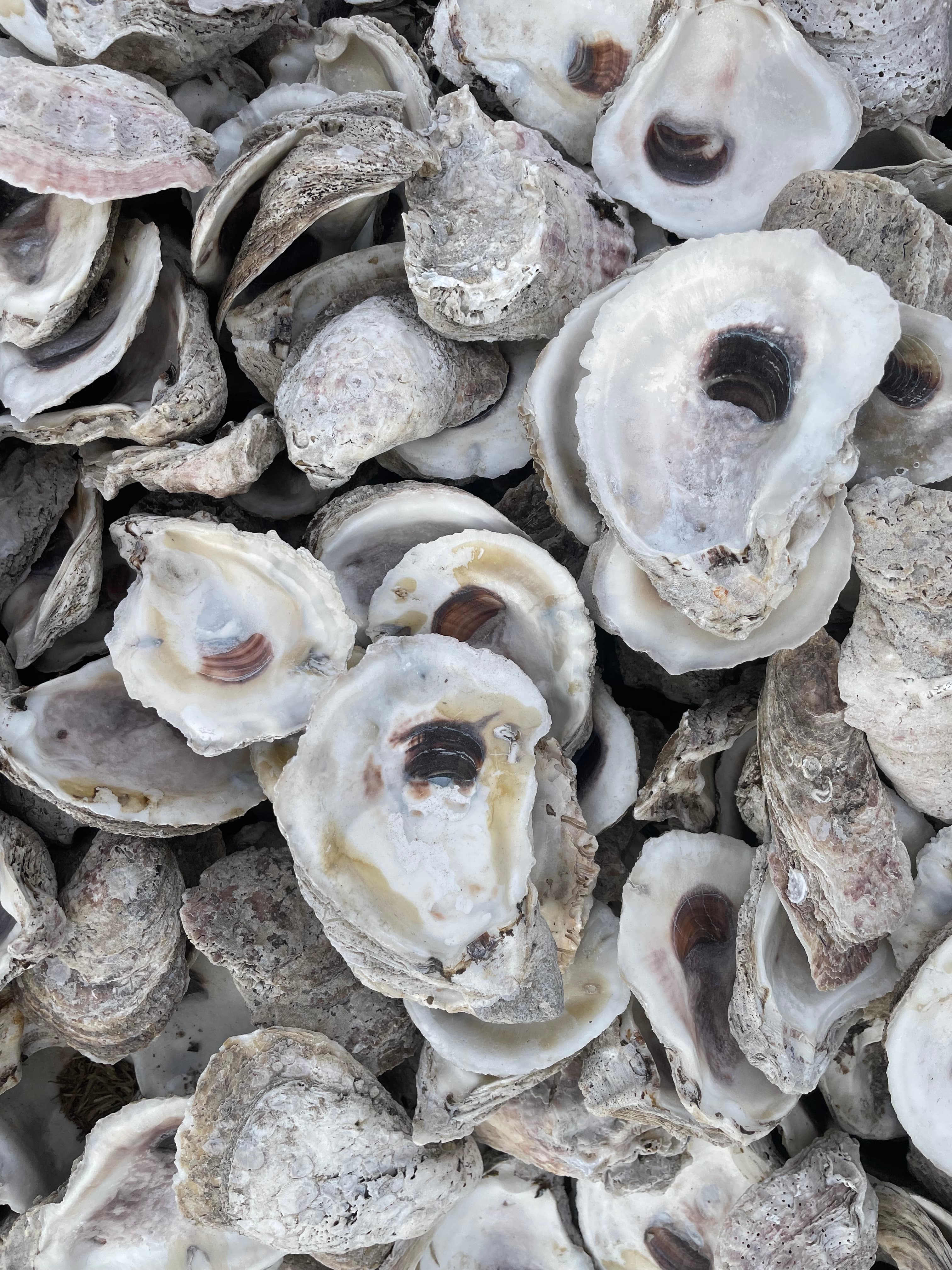
A single adult oyster can filter about 50 gallons of water in one day, removing small, suspended particles from the water and improving water quality and clarity. Consider the scale of this operation. A 130-acre oyster reef with 10 adult oysters per square meter will filter approximately 260 million gallons of water in a day. By comparison, it takes 39 wastewater treatment plants in Houston to filter a comparable amount.
Capture
Oysters capture carbon
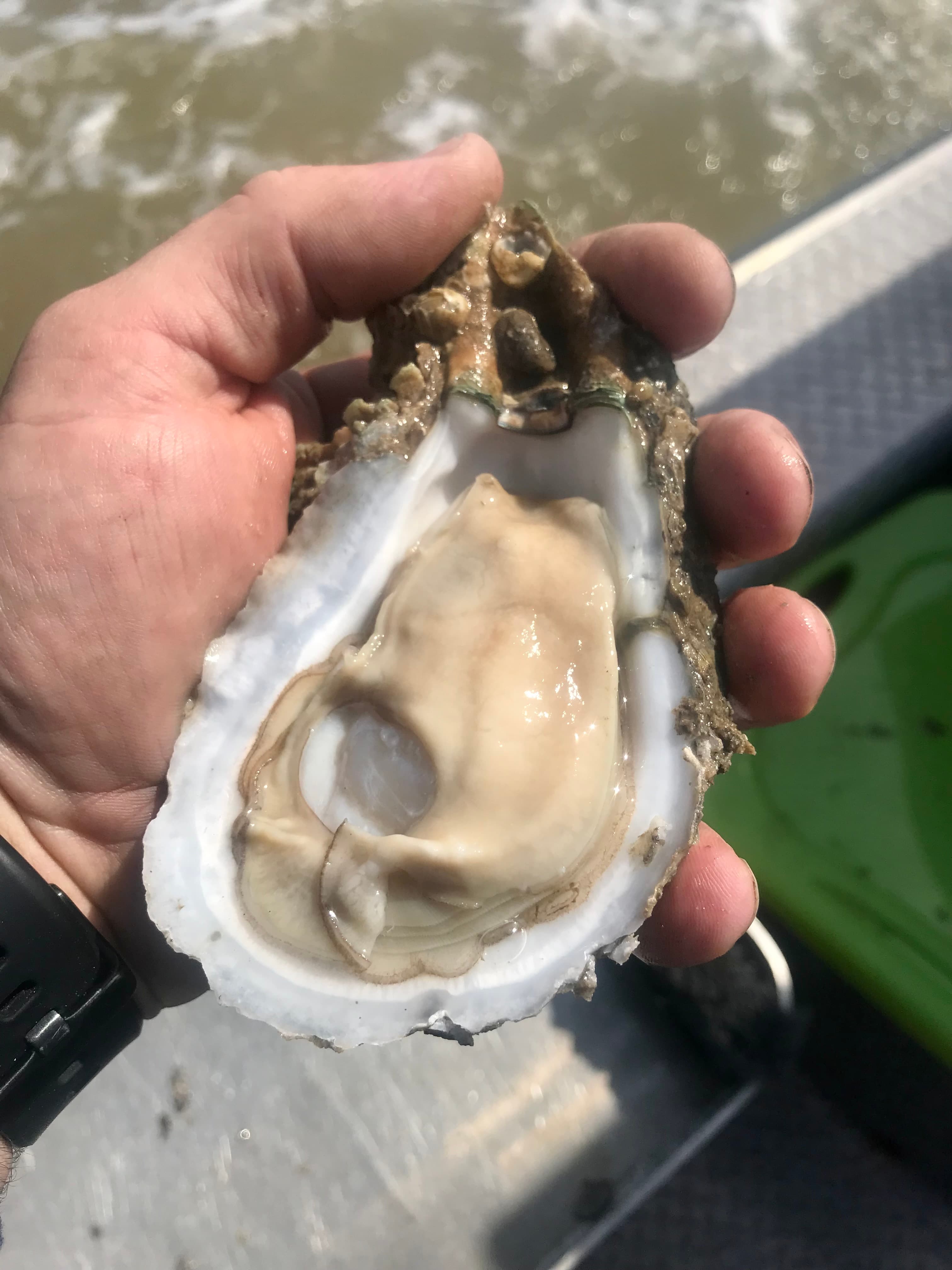
Oysters draw carbon out of the water column in two ways at once. They build calcium carbonate shell — carbon in mineral form, held in a durable structure. And they raise the ecological capacity of the whole bay system, increasing the steady state of carbon held in the estuary around them.2,3
Because the ocean and atmosphere exchange CO₂ continuously, carbon that an oyster reef captures and holds is carbon that cannot cycle back into the air.
Store
Oyster reefs store buried carbon for millennia
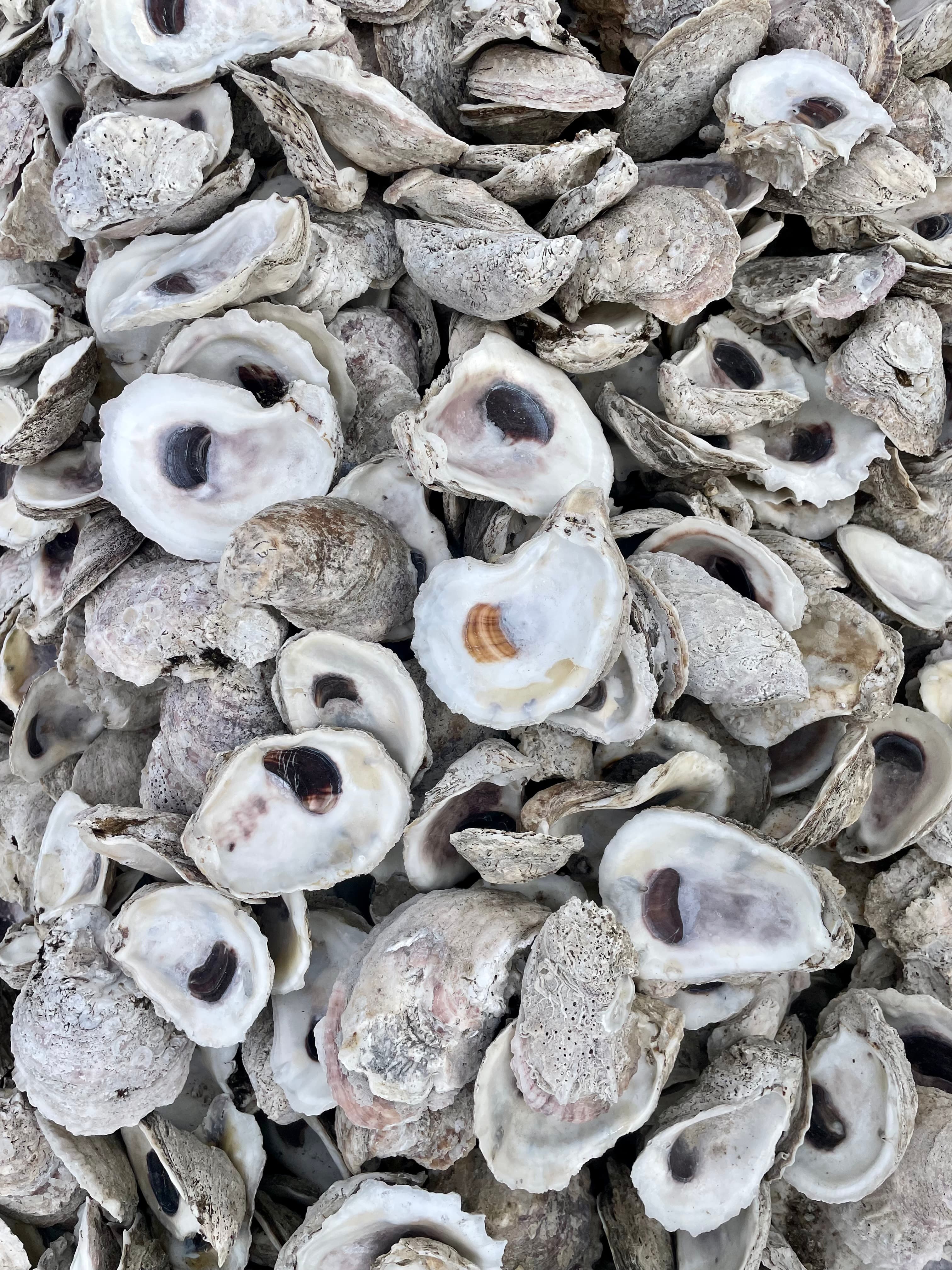
Researchers analyzing core samples from restored and natural reefs concluded that both organic and inorganic carbon — shell — are stored within and beneath oyster reefs. As the reef grows, shells and organic material become buried in a protective matrix beneath it.
Using carbon dating methods on historic reefs, those researchers determined that carbon buried millennia ago by oyster reefs was still securely stored in the sediment.4,5
This was also true for cores taken from historic areas where live reefs once existed but which are presently degraded, with no live oysters or reef above the mudline — the carbon stayed put even after the reef above it was gone.
Literature Cited
- 1Sabine, C.L., R.A. Feely, N. Gruber, R.M. Key, K. Lee, J.L. Bullister, R. Wanninkhof, C.S. Wong, D.W.R. Wallace, B. Tilbrook, F.J. Millero, T.H. Peng, A. Kozyr, T. Ono, and A.F. Rios. 2004. The Oceanic Sink for Anthropogenic CO2. Science. Vol. 305.
- 2Hadden, C.S., K.M. Loftis and A. Cherkinsky. 2018. Carbon isotopes (δ13C and Δ14C) in shell carbonate, conchiolin, and soft tissues in eastern oyster (Crassostrea virginica). Radiocarbon, Vol 60, Nr 4, 2018, p 1125–1137. DOI:10.1017/RDC.2018.27.
- 3Wong, C.M., C.H. Peterson, M.F. Piehler. 2011. Evaluating estuarine habitats using secondary production as a proxy for food web support. Mar. Ecol. Prog. Ser. Vol. 440: 11–25, doi: 10.3354/meps09323.
- 4Fodrie, F.J., Rodriguez, A.B., Gittman, R.K., Grabowski, J.H., Lindquist, N.L., Peterson, C.H., Piehler, M.F., Ridge, J.T., 2017. Oyster reefs as carbon sources and sinks. Proc. R. Soc. B Biol. Sci. 284, 20170891.
- 5Hurst, N.R., Locher, B., Steinmuller, H.E., Walters, L.J. and Chambers, L.G. (2022), Organic carbon dynamics and microbial community response to oyster reef restoration. Limnol Oceanogr, 67: 1157–1168. https://doi.org/10.1002/lno.12063

Next
The History: The Impact of Oyster Shell Mining